Downloaded Forrester ï½ Stretch Your Data Management Capabilities;tdwi Best Practices Report
When it comes to familiarizing yourself with any new engineering science at that place are always ii parts. Outset, yous need to understand its intended use example, and second yous demand to understand how to use/implement this technology in practice (and, for your ain good, you should do it strictly in that society). In this article I want to talk well-nighSQL Server FILESTREAM characteristic making sure that both parts are covered.
Main do good of any DBMS is an ability to store data in a structured fashion facilitating information retrieval combined with capabilities to manage your data, ensuring that you have such things every bit backups and security controls which tin be practical on the level of one management entity – database. You have some of these features with modern file organization level storage, but DBMS capabilities are richer.
Frequent business requirement you may run into is requirement to shop some large files so that they are linked/associated with all other business concern information which is stored in your LOB (line of business) database. Depending on business, these files tin can be anything from scanned originals of legal documents to audio, video, drawings or any other possible proprietary file format which stores information you need. Historically, there was no manner of storing these files or, in other terminology, BLOBs (binary large objects) in SQL Server database. Although file system serves well for storing files, it lacks in direction capabilities if compared with those provided by DBMS and potentially leaves your business organization data in two disconnected silos: database and file arrangement. This requirement drove search for ways of joining those 2 disparate data silos into one or at least connecting them in some style.
SQL Server FILESTREAM is i of the technologies assuasive you lot to do this. But let's look at what nosotros had before first. Prior to availability of SQL Server FILESTREAM characteristic possible answers to the problem described above were:
one) Storing data in table storage/VARBINARY(MAX) columns. This arroyo provides all the benefits of having all your data inside of database, including ability to ensure transactional consistency (meaning that BLOB information stored it the database bailiwick to all database constraints yous defined) and simplified management. Downsides of this approach are complicated admission to files for external applications and bloat of database size which may lead to overuse of premium storage infinite or violating database file size limits (for Express Edition).
Decision: with this approach your unstructured data is integrated into / stored in database with all storage and data management capabilities, only information technology cannot exist retrieved using conventional file organization APIs (your customer or intermediate layer application need to take care about this).
2) Storing links to the files locations on the file system in the database. This approach is free from downsides of one we just considered, simply it likewise free from its advantages. Using this approach means that data is nevertheless stored separately (adept affair you tin can access information technology via filesystem APIs) only you are not getting any DBMS data management capabilities available for this data (you lot rather getting a trouble of taking care about keeping in sync your database and file system storage combination, having two objects which you take to manage separately creating double work).
Conclusion: Feasible and simple solution which leaves BLOBs outside of DBMS control and only acceptable if you can afford associated management overhead and risks of missing unified controls over your data (e.thou. transactional consistency).
Enters FILESTREAM. This SQL Server feature allows varbinary(max) columns to store the data on the filesystem through use of peculiarly designated file groups which comprise directories acting equally data containers. Thus, we have data stored as files but integrated directly into DBMS so that nosotros can use backup and recovery and integrity protection features both for BLOB files and structured data.
FILESTREAM feature was offset introduced in SQL Server 2008 (known nether codename Katmai and released in August 2008) and currently available in any edition of whatsoever current version of SQL Server. As you lot tin judge from description above FILESTREAM is not a datatype but rather a setting/attribute you configure on varbinary(max) column which tells SQL Server that data must be stored on the file arrangement. This feature integrates SQL Server DBMS with NTFS/ReFS file arrangement. That gives you ability to use Transact-SQL statements to operate on this information (insert, update, query, search, backup) combined with ability to use streaming APIs and performance of file system and all this maintaining transactional consistency both for structured and unstructured information.
FILESTREAM improves DBMS performance every bit FILESTREAM columns not cached in SQL Server buffer pool, using the NT organisation cache instead. This saves more SQL Server buffer pool memory for query processing. With FILESTREAM enabled you can use both Transact-SQL and Win32 to manage the FILESTREAM information.
Although data is stored in the grade of files (and potentially accessible via conventional filesystem APIs) we are still missing total Windows application capability with FILESTREAM as data cannot exist accessed using not-transactional streaming and Windows applications are non enlightened of database transactions. It besides means that there is no full compatibility with the file systems API for file and directory information. As FILESTREAM Win32 streaming support works simply in the context of SQL Server transactions nosotros cannot delete or rename FILESTREAM files through the file system.
Decision: With FILESTRAM y'all become transactional consistency and power to use streaming APIs and performance of the file system. Filesystem APIs/streaming back up is limited by transactional mode only. This option is better than solutions which we had before combining benefits of SQL Server management and file system functioning.
Any downsides/limitations? Limitation here is that using FILESTREAM implies writing some custom lawmaking to let Windows customer applications to access this information. FILESTREAM does non take full Windows API file and directory storage compatibility and does not back up not-transactional access.
With FILESTREAM Win32 streaming support works in the context of a SQL Server transaction. Within a transaction, information technology is possible to use FILESTREAM functions to obtain a logical UNC file system path of a file. Side by side you tin apply the OpenSqlFILESTREAM API to obtain a file handle. This handle can then be used past Win32 file streaming interfaces, such as ReadFile() and WriteFile(), to admission and update the file by manner of the file system.
When you may want to employ it? To put it simply apply of FILESTREAM can be considered in the following scenarios:
- When you need to store files larger than 1 MB (use conventional table storage for smaller files)
- When fast read access is important
- When y'all have database file size limits imposed by SQL Server edition limitations which y'all demand to overcome (e.g. Express edition has maximum database size limit of 10 GB, i.e. you take x GB to store relational data, but FILESTEAM data is not a field of study to this restriction)
To sum it up, if your LOB database needs to include large files you can leverage file stream to optimize operation and have benefits of managing this data as a part of DBMS.
Now with intended use instance and limitations of FILESTREAM applied science clarified we tin can move on to practical side of things.
Commencement of all, FILESTREAM needs to be enabled on the SQL Server example level. It is not enabled by default during installation or upgrade of SQL Server instance, though you lot can enable information technology on the Database Engine Configuration step in the SQL Server Setup Sorcerer:
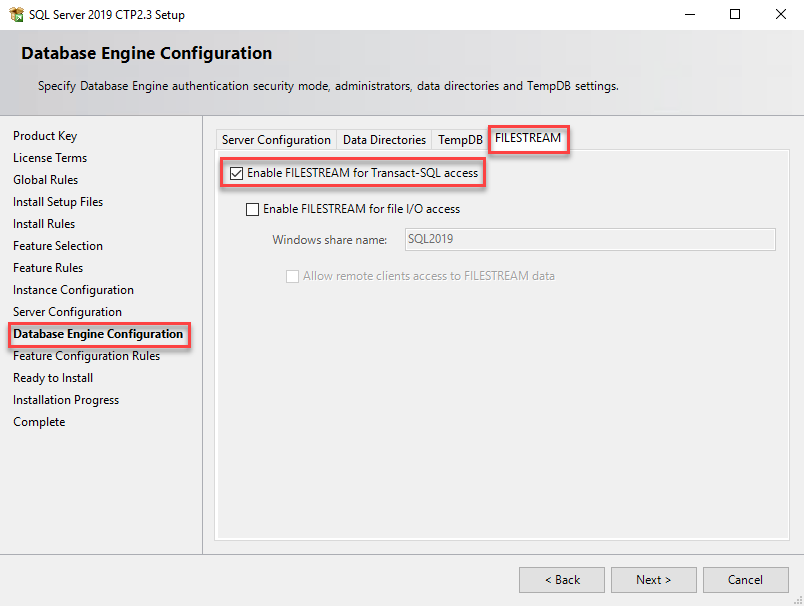
Unremarkably FILESTREAM configuration performed post installation using SQL Server Configuration Director and SQL Server Management Studio (SSMS). To check if it is enabled y'all can use sp_configure system stored procedure:
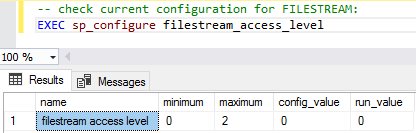
If your config_value ready to 0 it ways that FILESTREAM is disabled and you need to set information technology config_value to ii to enable information technology. Alternatively, you can verify configuration land navigating to SQL Server Configuration Manager > SQL Server Services selecting your SQL Server Case and accessing its properties where yous will find FILESTREAM tab:
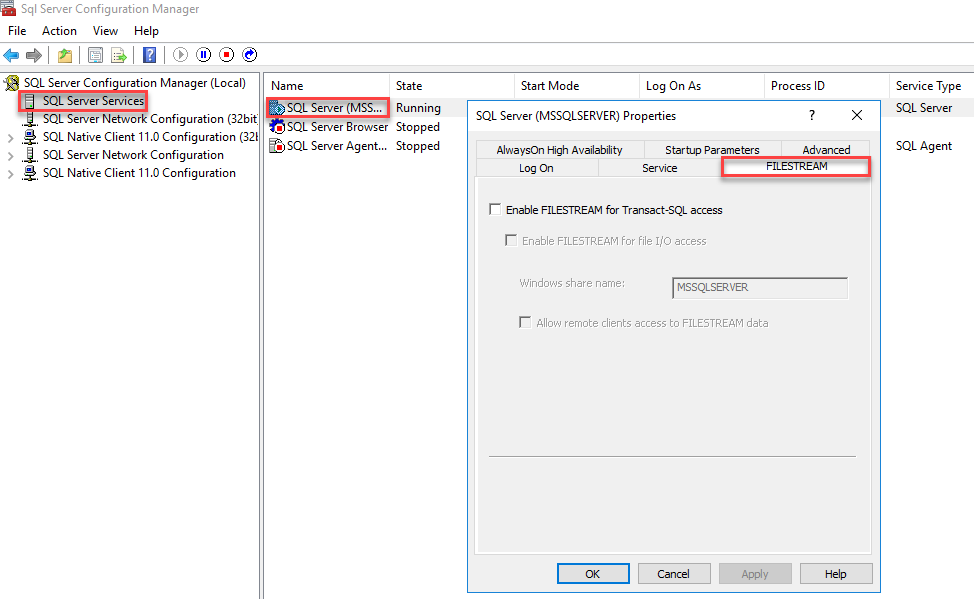
We tin can enable FILESTREAM using Transact-SQL/SSMS and SQL Server Configuration Manager.
Let'south enable FILESTREAM using sp_configure stored procedure equally shown beneath:
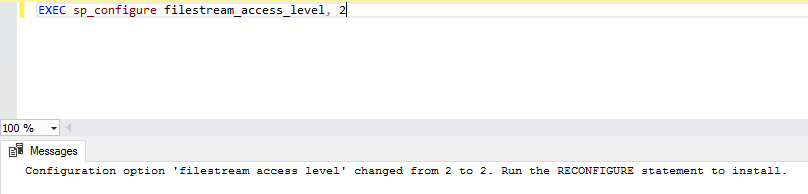
Executing this control will change your config_value from 0 to two:
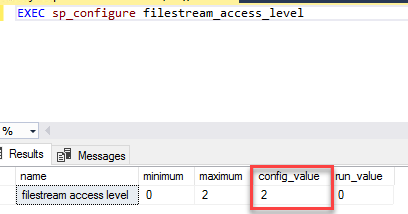
Yous may exist a lilliputian chip confused by the message you will receive after irresolute FILESTREAM_access_level which says: "Configuration pick 'FILESTREAM access level' changed from 0 to two. Run the RECONFIGURE statement to install." If y'all try to run RECONFIGURE after this, you will run across the following message: "FILESTREAM feature could not be initialized. The operating system Ambassador must enable FILESTREAM on the instance using Configuration Manager."
Your next step afterward changing configuration with sp_configure will be switching over to FILESTREAM tab of instance properties in SQL Server Configuration Director and ticking Enable FILESTREAM for Transact-SQL access likewise equally Enable FILESTREAM for file I/O access checkboxes, adjusting Windows share name if necessary (it defaults to MSSQLSERVER in case of default instance or to instance name in case of named instance) optionally you may tick Let remote clients access to FILESTREAM data:
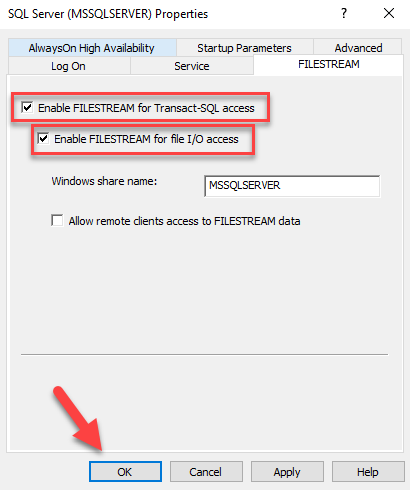
Click OK in Instance properties and restart your SQL instance to go this setting practical:
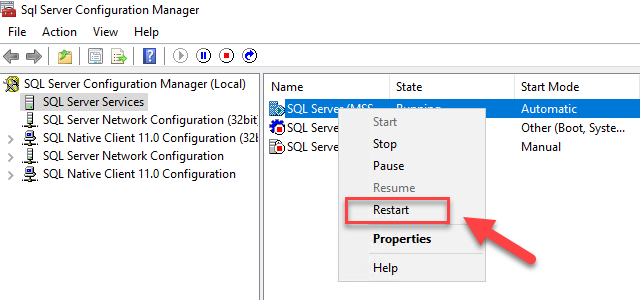
One time restart completed you can execute EXEC sp_configure FILESTREAM_access_level command over again and meet that we have both config_value and run_value set up to 2:
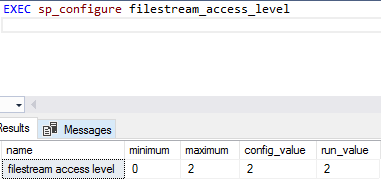
Now we tin can add FILESTREAM enabled file group and file and start using FILESTREAM. To add FILESTREAM file group you can use SSMS GUI (Database Properties > Filegroups):
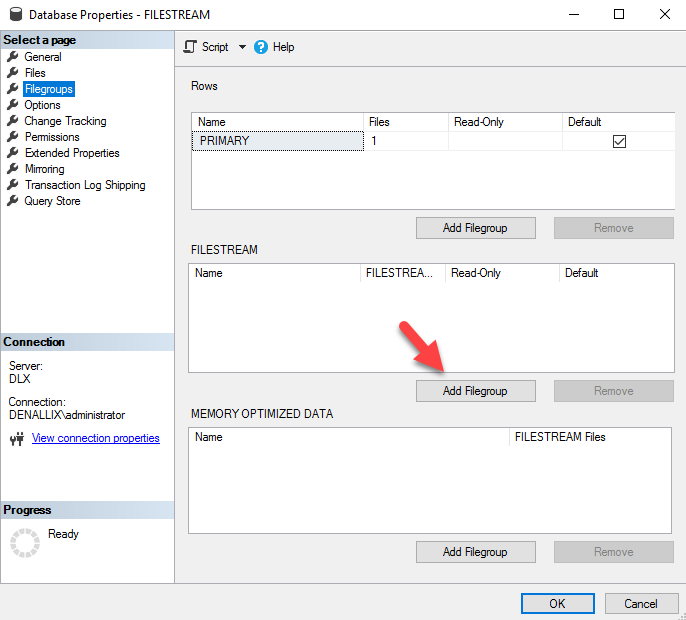
And T-SQL can be used to do the same besides:
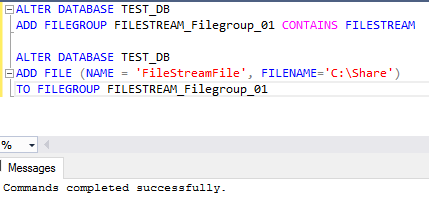
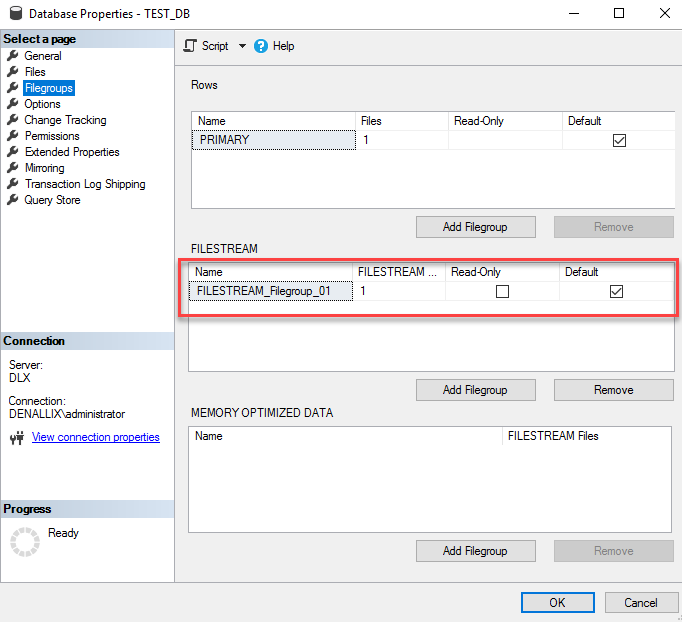
In one case you executed commands shown above you will encounter that FILESTREAM filegroup has been added to your database:
You will as well see that binder you specified in SQL script is created with FILESTREAM.hdr file and $FSLOG folder inside:
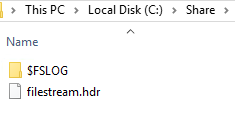
FILESTREAM.hdr file used to shop FILESTREAM header information (metadata describing information container) and $FSLOG directory acts as a FILESTREAM equivalent of the transaction log. Subsequently subdirectories will exist created in this folder for each table and within of those there will be subdirectories foreach FILESTREAM cavalcade inside the tabular array with GUIDs acting every bit a file names for all these file arrangement objects.
We can now create table with FILESTREAM column:

Notation that for FILESTREAM table you must have column marked as ROWGUIDCOL which allows you to have immutable column separate from the chief key, otherwise on attempt to create table you lot volition receive this error message: "A table that has FILESTREAM columns must have a nonnull unique cavalcade with the ROWGUIDCOL property."
And in one case table is created we tin either salvage existing file into our FILESTREAM column or convert some text into binary format and save it:
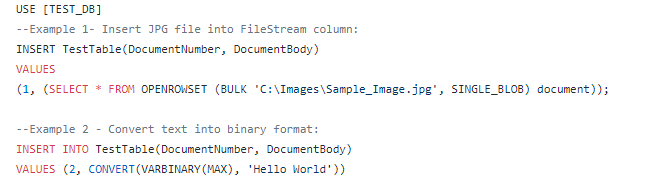
You will run into that our binary data was stored in database and GUID was assigned to each tape every bit ID:

Yous can access these files through file system, simply there is no piece of cake way to locate files within GUID based folder structure with files named with GUIDs and having no extension. Nonetheless you tin locate the file and open it from file organization (it is particularly piece of cake in the starting time when y'all have only a few files stored in FILESTREAM container):
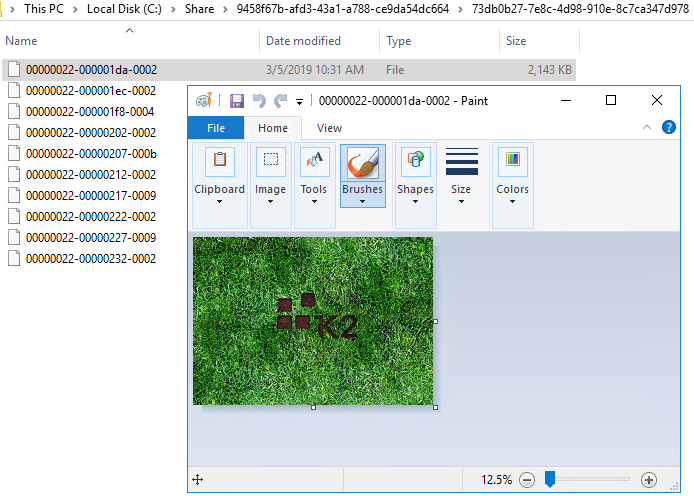
The main limitation of this feature is requirement to write custom code to locate and open file. As explained in Microsoft documentation you tin can use Win32 APIs to create customer applications for FILESTREAM data, in particular to obtain Win32 handle to read data from FILESTREAM hulk. The OpenSqlFILESTREAM API obtains a Win32 file handle which application can use to stream the FILESTREAM information, and tin further pass to the following Win32 APIs: ReadFile, WriteFile, TransmitFile, SetFilePointer, SetEndOfFile, or FlushFileBuffers. Keep in heed that, to access the FILESTREAM Blob by using Win32, Windows Authorization must exist enabled (i.e. you must apply Integrated Hallmark with FILESTREAM). You can find some relevant lawmaking samples in Admission FILESTREAM Data with OpenSqlFILESTREAM department of Microsoft documentation.
VSAN from StarWind is software-defined storage (SDS) solution created with restricted budgets and maximum output in mind. It pulls shut to 100% of IOPS from existing hardware, ensures high uptime and mistake tolerance starting with just ii nodes. StarWind VSAN is hypervisor and hardware agnostic, allowing yous to forget nearly hardware restrictions and crazy expensive physical shared storage.
Build your infrastructure with off-the-shelf hardware, calibration however you like, increase render on investment (ROI) and enjoy Enterprise-form virtualization features and benefits at SMB cost today!
To conclude this article, I must mention that starting from SQL Server 2012 some other option for storing Blob in the database is bachelor. This pick is built on top of FILESTREAM and known as FileTables. FileTables introduces specialized user tabular array with pre-defined schema which stores FILESTREAM information along with directory hierarchy information and file attributes. FileTables accost shortcomings of FILESTREAM feature mentioned above, i.e. provides more complete Windows API compatibility and non-transactional access to files. Yous may read upward about selecting between those two options in Compare Options for Storing Blobs (SQL Server) section of Microsoft documentation, and I remember more detailed overview of FileTables can exist a good topic for one of the adjacent articles.
Farther reading / sources:
FILESTREAM (SQL Server)
Compare Options for Storing Blobs (SQL Server)
Create a Table for Storing FILESTREAM Information
Admission FILESTREAM Data with OpenSqlFILESTREAM
Create Client Applications for FILESTREAM Data
- SQL Server Always Encrypted characteristic explained
- Migrating K2 database to a different SQL Server instance – how to copy SQL Server instance Chief Fundamental
DOWNLOAD HERE
Posted by: kunzcomforse.blogspot.com

